Technology is a key component of our SmartCORE pilots. Every pilot is led by an energy community that generates renewable energy and implements strategies to optimise its local consumption. In every country, this energy community works hand in hand with a technical partner that is developing accessible tools to monitor and predict energy production and consumption, with the aim of supporting data-based decision-making and potentially enabling automated control systems. Because our technical partners mostly work behind the scenes, we want to understand the potential of these tools and how they are helping to build more efficient energy systems at community level.
We start our series of interviews with our Belgian technical partner. Since 2010, EnergieID has helped more than 70,000 households and small businesses monitor their energy use. We spoke to Vincent Dierickx, co-founder of the cooperative and a key player in the integration of the different SmartCORE energy management tools. Robustness and reliability are essential in the tools they are developing, but so are inclusiveness, openness, and interoperability.
What problem is your SmartCORE technology designed to solve for energy communities? What will it enable them to do that they could not easily do before?
Today, the real-time energy market is increasingly driven by data. If communities want to thrive in this market, good data management is essential. EnergieID helps energy communities build data management capacity and business processes to optimise their market performance.
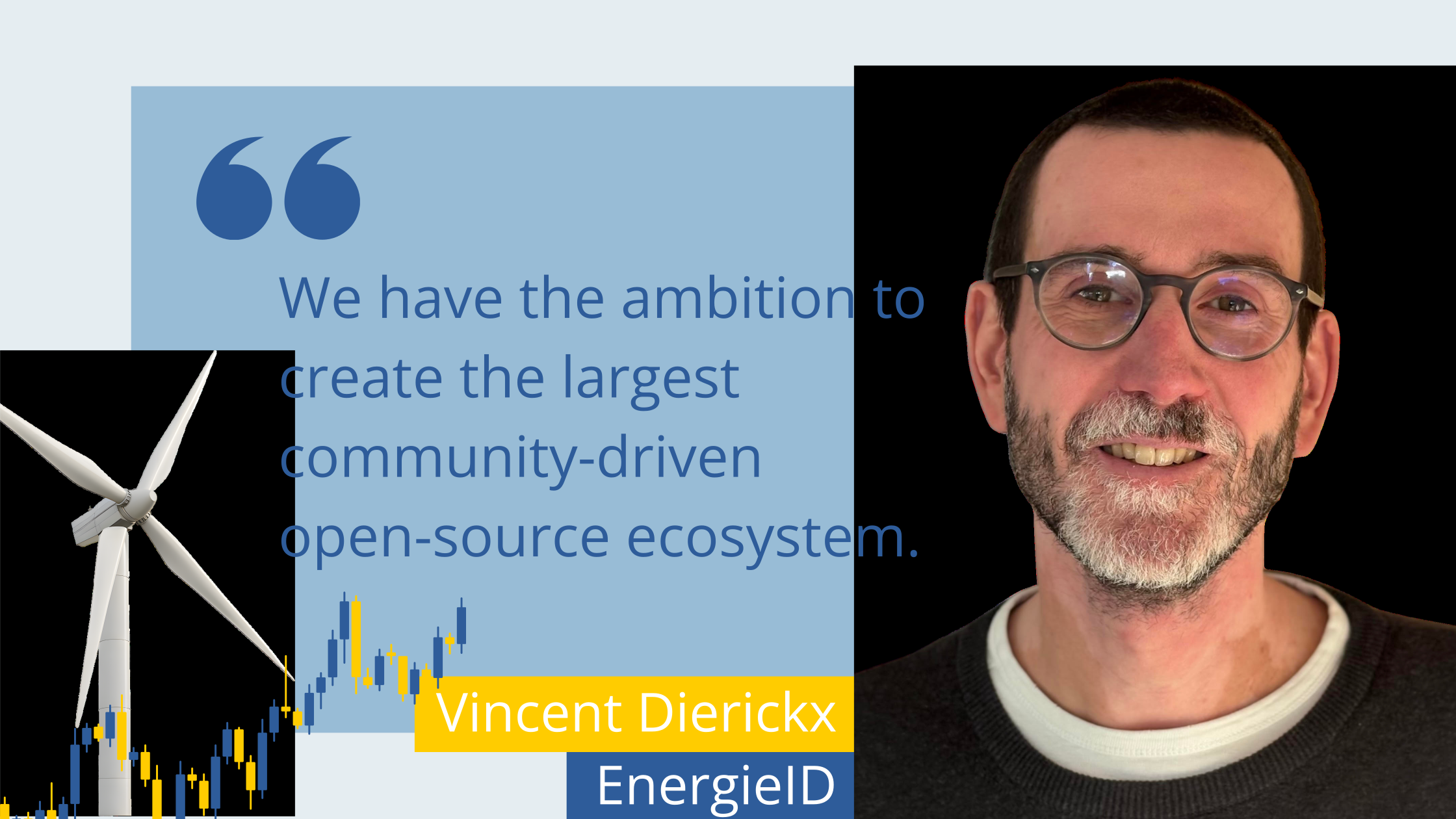
At EnergieID, we have the ambition to create the largest community-driven open-source ecosystem, which started with the Horizon 2020 project REScoop VPP. Under this project, we developed two components: COFY Cloud and COFY Box. Whereas COFI Cloud encompasses all tools for high-performance back-office applications and community control, COFY Box is an open-source energy management system (EMS) based on Home Assistant, although this could also be Homey or any other open EMS.
In the context of SmartCORE, we mainly support the French pilot led by EPV and the Belgian pilot managed by Ecopower, providing tools tailored to their specific use cases. We are developing the solutions so that they can be transposed to other cases around Europe.
What have been the main technical challenges encountered in your pilot so far? What are the proposed solutions?
Our first task was to create a solid foundational architecture. We built our tools to be independent of any major cloud provider, so that communities can choose smaller EU-based providers. We also needed a system to curtail solar PV and wind installations in the field that is secure and reliable, yet economical and open.
On the operational side, we are developing and running a back office for Ecopower and EPV to enable their use cases. With Ecopower, we developed a system that turns market information, such as electricity prices, into control signals and delivers them reliably to devices in the field, so that equipment can adjust its production or consumption as market conditions change.
We are also building interfaces that allow less technical managers to operate the tools, and documenting our developments so that others can use them.
You have many years of experience in this field - what are the main trends you have observed in energy flexibility and data management over the past few years?
We are at a point where there is green energy abundance at certain times. We should celebrate this as a successful first phase of the energy transition, but it creates a new set of problems: low and negative prices and grid congestion. This forces energy communities to reinvent their businesses, moving from being only producers to becoming flexible energy suppliers able to shift production or consumption whenever appropriate. Successful communities therefore know how to operate their assets based on reliable market information and to shift consumers towards periods of abundant energy.
Flexibility is a very technical field that might not be very accessible for many energy communities. What are your best recommendations and technical foundations for an energy community looking to start energy management strategies?
First, start with collecting data. Make sure you have energy monitoring in place, starting with your own collective assets, so you can monitor their performance. We also make energy monitoring easy and accessible for members and their families. Next, work towards controlling your assets based on day-ahead prices and work on forecasting. If you master forecasting, you can think about taking on imbalance risks. Lastly, help your members understand how to shift their consumption towards better moments. This starts with easy-to-understand information, but will evolve into fully automated home energy management systems.
The power of communities lies in their unique relationship with their members: they are a trusted partner that respects members' privacy and independence. That is why we are collaborating on open-source technology, so that the communities can put these tools into practice as easily as possible.
Looking ahead, what do you think energy communities will need from digital tools that they don't have today?
Communities will operate as one organic, flexible asset based on a reliable, secure and accessible Community EMS. It will enable communities to produce the cheapest possible renewable energy locally and independently for their members and local community.